
We turn expert knowledge, business rules, processes, systems, and constraints into a verified domain model that gives teams and AI the context they need to build software around business reality.
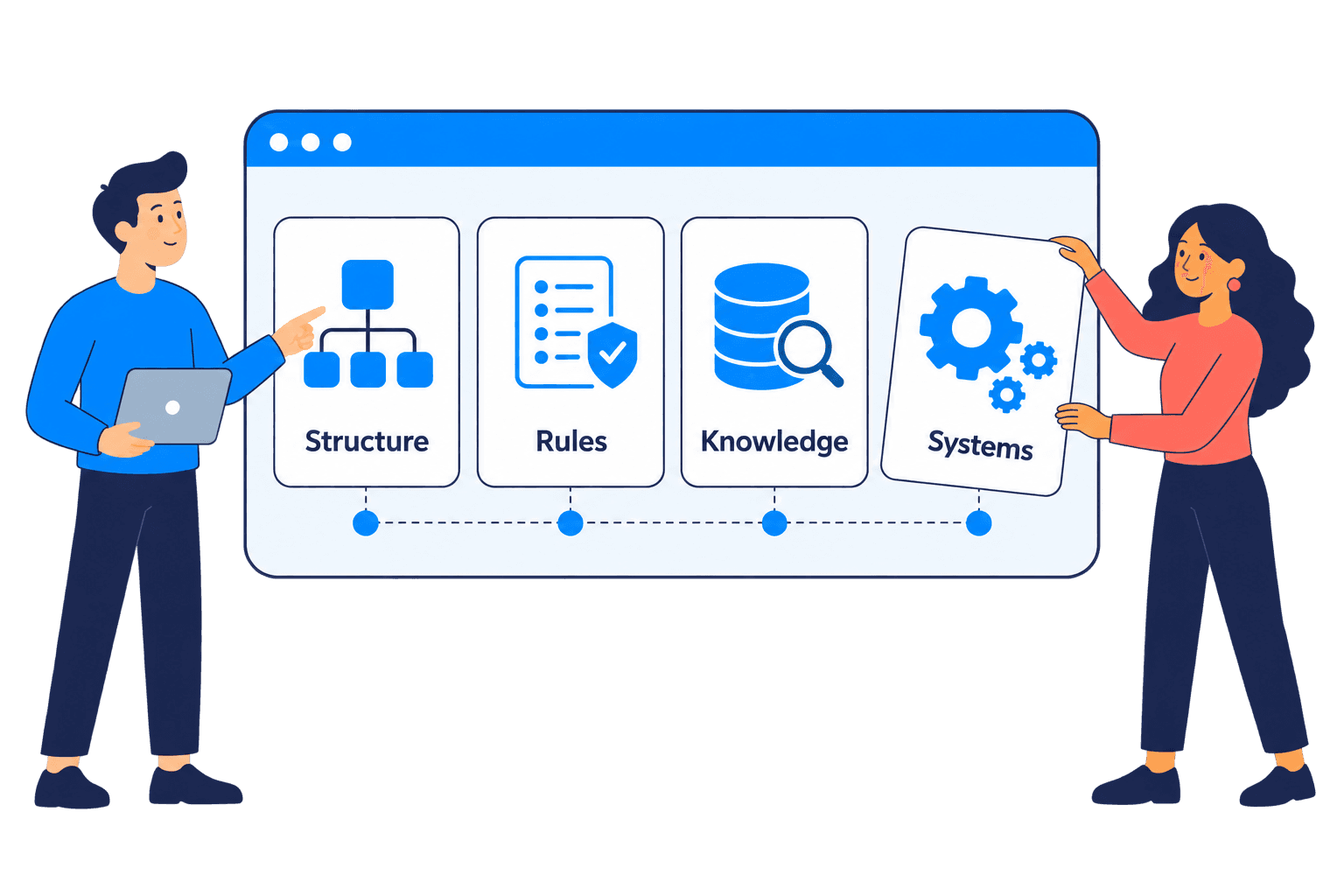
The business knowledge software depends on is usually scattered across experts, documents, systems, and existing applications. Important rules, decisions, relationships, and exceptions remain implicit. Teams have to reconstruct that context as work moves through product, architecture, development, and testing—adding analysis, review, correction, and rework.
AI needs a structured understanding of the business.
AI can generate requirements, designs, architecture, code, and tests quickly. But speed alone does not make those outputs correct for a specific business domain.
Domain Modeling makes the underlying business context explicit and connected, giving AI and software teams a reliable foundation for downstream work.
A verified model of the domain your software must support
We model the business independently of how current software happens to represent it, then connect that business view to the systems and information that support it today. The result is a structured representation of the domain that can be reused across product decisions, requirements, architecture, engineering, testing, process improvement, and automation.
We lead the knowledge extraction, analysis, modeling, consolidation, and validation. Your team provides existing materials, system context, and access to the people who understand how the domain actually works.
The model connects the major elements of the domain so they can be understood together rather than through separate documents, systems, and individual expertise.
Shows how responsibilities are organized and how organizational areas relate to the domain.
Defines what the organization or domain must be able to do, independently of current software or implementation choices.
Shows where business work is owned, managed, coordinated, and governed.
Maps processes, activities, decisions, handoffs, rules, constraints, exceptions, and operational relationships.
Structures the knowledge, expertise, rules, and supporting assets required to perform the work correctly.
Connects the applications, systems, information sources, and existing software that support the domain.
Identifies manual activities, unsupported process steps, missing knowledge, and areas where existing software does not fully support operations.
Identifies areas where work could be improved, augmented, or automated based on the combined view of operations, knowledge, systems, and gaps.
We distinguish how the domain actually operates from how existing applications currently model or support it.
Rules, decisions, exceptions, responsibilities, and operating knowledge are captured instead of remaining dependent on individual experts.
Business structure, operations, knowledge, systems, and gaps are analyzed as related parts of the same domain.
Existing documentation and systems provide the starting evidence, while structured expert input fills the context that was never formally documented.
The emerging model is checked with domain experts so unresolved assumptions and contradictions can be identified before the model is reused.
The model is structured to support software and AI work rather than becoming documentation that exists only for reference.
A clearer domain foundation improves the decisions and outputs produced throughout software development.
Teams spend less time rediscovering business context before they can define what needs to be built.
Critical knowledge becomes reusable instead of requiring the same experts to repeatedly explain how the business works.
Rules, constraints, exceptions, and dependencies can be identified before incorrect assumptions reach implementation.
Product, architecture, engineering, and QA work from the same interpretation of the domain.
AI works with company-specific business context rather than relying primarily on generic knowledge and local prompts.
System boundaries, integrations, responsibilities, and information flows can be evaluated against the domain they must support.
Business scenarios, rules, exceptions, and operational relationships provide stronger context for acceptance and system-level testing.
Manual gaps and unsupported work become visible in context, helping teams identify where deeper automation could create value.
We combine existing evidence with expert knowledge, progressively structure the domain, and validate the resulting model before it becomes a foundation for downstream work.
Establish the boundaries of the domain and identify the business areas, systems, sources, and stakeholders that need to be understood.
Analyze existing materials and conduct structured expert interviews to capture information that is missing, implicit, or distributed across the organization.
Structure the findings into the required business, operational, knowledge, systems, and supporting domain models.
Map relationships across the models and identify missing information, contradictions, dependencies, manual gaps, and relevant automation opportunities.
Review the connected model with domain experts, resolve material issues, and consolidate the verified domain foundation for downstream use.
Domain Modeling fits organizations whose software depends on substantial business knowledge that is still distributed across people, documentation, systems, and existing applications. It is particularly useful when the organization wants to move toward AI-powered software development, reduce dependence on repeated expert interpretation, improve consistency across the SDLC, or establish stronger business context before major product, architecture, process, or automation work.
If the domain is already well understood and the main question is what the product should become in an AI-first market, AI Product Strategy is the better next step. If product direction is established and the primary challenge is system architecture, Architectural Consulting may be the better fit.
We will review how business knowledge is captured today, where important context remains implicit, and whether a structured domain model would improve your software and AI initiatives.